
Fashion Trends & Future, Fashion Education, Designers & Ateliers
How Big is the Vintage and Secondhand Fashion Market?


The Vintage and secondhand Fashion Market – Created by Dinis Guarda with AI tools for Fashionabc
The vintage and secondhand fashion market has moved from niche subculture to a genuine economic engine. As of early 2026, the sector is growing roughly two to four times faster than traditional retail, and its trajectory through 2030 is being shaped by a convergence of consumer economics, brand adaptation, and increasingly, agentic AI.
Secondhand and vintage fashion is no longer a scattering of local thrift shops. It is a highly digitised, multi-billion-dollar ecosystem, and it’s now the fastest-growing segment of global retail.
“Resale is no longer just growing, it’s taking direct market share,” says James Reinhart, ThredUp’s cofounder and CEO. “In 2025, the U.S. secondhand market grew nearly 4X faster than the broader retail clothing market.”
Defining the Industry: Secondhand vs. Vintage
The two terms are often used interchangeably, but the industry draws a real distinction between them, based on age, intent, and scarcity.
| Category | Definition | Key Characteristics & Drivers |
| Secondhand (Resale / Re-commerce) | Any garment, shoe, or accessory that has been previously owned, regardless of age | Driven by affordability, value, and volume. Includes modern fast fashion, mid-tier mall brands, and contemporary luxury handled by major platforms (e.g., Vinted, ThredUp) |
| Vintage Fashion | Items 20 years or older (currently centred on the 1980s, 1990s, and early Y2K eras) | Driven by scarcity, individuality, and nostalgia. These pieces tend to hold or appreciate in value and rely heavily on curation |
Major Industry Themes
The structural shift running through 2026 and into 2030 rests on five pillars.
The “Resale Flywheel” (Closets as Assets)
Consumers, particularly Gen Z and Millennials, increasingly treat their wardrobes like stock portfolios.
- The Pre-Purchase Calculation: Roughly 60% of consumers now check an item’s eventual resale value before buying it brand new.
- Continuous Liquidity: Instead of holding onto clothes for years or donating them, sellers are shifting toward a mindset of continuous liquidity, treating resale platforms as a rotating credit facility to fund their next purchase.
Breaking the Secondhand Supply Bottleneck via AI
Historically, resale had a massive scalability problem: every single item is a unique SKU ($SKU = 1$) requiring individual photography, description writing, authentication, and pricing. AI has systematically solved this operational friction.
- Automated Intake: Multi-modal AI tools can generate an optimised, search-friendly marketplace listing from a single smartphone photo, auto-detecting brand, fabric, and pricing.
- Agentic Commerce: Buyers are deploying AI “agents” that scour multiple resale networks 24/7 to auto-negotiate prices and find rare items.
From Search Bars to Algorithmic Feeds
Secondhand shopping has largely detached from the standard e-commerce grid. Close to half of resale discovery now happens through social commerce, creator recommendations, and algorithmic livestream feeds — TikTok Shop and Whatnot among them — rather than a typed keyword search. Vinted CEO Adam Jay describes it as a deeper behavioural change, not a temporary reaction to prices: “It’s a fundamental change in consumption towards secondhand, and I think that is very much here to stay.”
Branded Resale & RaaS (Resale-as-a-Service)
Legacy brands are wary of losing lifecycle ownership of their own products to third-party apps. Rather than cede that margin, many are partnering with resale infrastructure providers to launch their own loops — Zara Pre-Owned and Lululemon Like New among them — letting customers trade in old items for store credit.
Regulatory and Legislative Pressure
Governments are stepping in to curb textile waste. Extended Producer Responsibility (EPR) laws moving through the EU and parts of the US are beginning to penalise brands for excess waste, turning resale infrastructure from a sustainability talking point into a genuine legal and financial buffer for major fashion corporations.
The Macro Metrics: Mapping a $393 Billion Market
ThredUp’s 2026 Resale Report, produced with GlobalData, puts the global secondhand apparel market at $257 billion in 2025, on track for $289 billion in 2026, and projected to reach $393 billion by 2030 — roughly 10% of all global apparel spend.
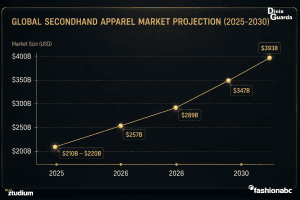
Global Secondhand Apparel Market Projection (2025-2030) – Created by Dinis Guarda with AI tools for Fashionabc
“The global secondhand market is entering a more competitive, structurally complex phase,” says Neil Saunders, GlobalData’s Managing Director and Retail Analyst. “We expect the U.S. market alone to reach $78.8 billion by 2030. With Gen Z and Millennials driving the vast majority of this value, the infrastructure for discovery must evolve into the social feeds where these consumers live.”
A few structural details stand out within that headline number:
- The velocity gap: Secondhand fashion is growing roughly two to four times faster than traditional brick-and-mortar retail.
- The gender core: Women’s wear still anchors the ecosystem at around 52% of market share, thanks to higher wardrobe turnover and platform integration (Depop, Vinted). Kids’ wear, however, is logging the fastest compound growth rate.
- The mid-range sweet spot: Luxury resale gets the press, but mid-range items make up 45% of volume — a necessary release valve for consumers trading down from mid-market retail under continued cost-of-living pressure.
The “Asset Mindset” and Brand Anxiety
The defining psychological shift of 2026 is that Gen Z and Millennial consumers no longer treat clothing as a sunk cost. They manage their closets more like a liquid portfolio than a wardrobe.
The Apparel Flywheel Effect 60% of consumers now factor resale value into a purchase decision before buying something new, and 57% are actively using resale as a supplemental income stream. The closet, in effect, has become a rotating credit line.
Retailer Existentialism Traditional retailers are increasingly aware that a missing resale mechanism is a competitive liability, not a neutral gap:
- 58% of traditional retailers admit that the absence of a resale platform actively hurts them.
- 42% of executives say they’ll lose meaningful Gen Z and Millennial market share if they fail to scale a Resale-as-a-Service pipeline.
Brands including Lululemon, Zara, J.Crew, and Madewell are now among the highest-volume cross-over players, active in both primary and secondary markets simultaneously.
The Intelligence Engine: How AI Is Unlocking the Market
The industry’s most persistent constraint has always been supply-side friction. Unlike standard retail, every pre-loved item is a unique SKU, requiring manual photography, condition grading, pricing, and description writing. In 2026, large language models and computer vision have scaled to address that bottleneck directly.
AI-Driven Supply Optimisation
- The “digital closet”: 66% of consumers say they’re comfortable letting AI agents scan their purchase history via emails and store profiles, cross-referencing past buys against real-time resale demand and flagging items at peak resale liquidity.
- Zero-friction listing: A single smartphone photo now lets multi-modal models extract brand, fabric composition, original retail price, style name, and condition — auto-generating an SEO-optimised listing in under three seconds.
Autonomous Demand Agents
- Agentic shopping: 63% of Gen Z consumers use AI agents that scan hundreds of resale platforms around the clock, hunting for specific vintage pieces or price anomalies.
- Automated haggling: Nearly six in ten shoppers now let AI tools negotiate and counter-offer with sellers on their behalf, removing the friction of manual back-and-forth.
Reinhart, whose company has processed more than 200 million secondhand items, frames the supply challenge as the real ceiling on growth, not demand: “The next phase of this market will be defined by who can best unlock supply and use AI to connect that inventory with the next generation of shoppers.”

How Big is the Vintage and Secondhand Fashion Market? – Created by Dinis Guarda with AI tools for Fashionabc
Key Segments Driving the Market
The vintage and secondhand business is no longer confined to thrift stores — it’s a multi-tiered ecosystem shaped by technology and sustainability mandates.
| Segment | Market Characteristic | Key Insight |
| Luxury Resale | Highest value | Brands including LVMH and Prada are registering items with Digital Product Passports to guarantee authenticity |
| P2P Marketplaces | Highest volume | Platforms like Vinted (valued near $9 billion) and Depop dominate the Gen Z segment |
| Brand-Owned Resale | Fastest growing | Retailers such as Allbirds and Arc’teryx are launching their own Resale-as-a-Service programmes to capture their products’ full lifecycle |
Why It’s Accelerating in 2026
- Economic pragmatism: Amid sustained cost-of-living pressure, buying pre-loved has become the top money-saving tactic for consumers globally.
- Regulatory pressure: Laws such as California’s Responsible Textile Recovery Act and new EU circularity rules are pushing brands to ensure garments are reused or resold rather than discarded.
- AI-powered selling: New tools let sellers photograph an item and have AI identify the brand, SKU, and original retail price, then write the listing — lowering the barrier to entry for new sellers substantially.
- Livestream auctions: Platforms like eBay Live and Whatnot have turned vintage shopping into entertainment, with live auctions for rare streetwear and watches driving significant engagement.
Looking Ahead to 2030
Between now and 2030, the market’s path will largely be set by policy pressure and infrastructure maturity. EPR regulation is closing in across the EU and parts of the US, forcing fast-fashion manufacturers to help fund textile waste management. That regulatory weight has already pushed resale from a sustainability talking point to an operational hedge: the companies that come out ahead this decade will likely be the ones that manage to monetise a single garment two or three times over its lifecycle, not once.
Status, too, is being redefined. In 2026, curation increasingly outranks newness — owning a rare 1990s archival piece now often carries more social currency than buying the newest release off the rack. As Jay puts it, describing Vinted’s own ambition for the category: “We’re on a mission to make secondhand the first choice, because we know there’s huge value in what’s sitting at the bottom of closets across the country.”
That’s the throughline for the sector heading into 2030 — resale isn’t a side market anymore. It’s becoming the infrastructure the rest of the industry has to build around.


