
Fashion Tech & AI, Designers & Ateliers, Fashion Education, Fashion Trends & Future
How Many Fashion Influencers Are in the World?

How Many Fashion Influencers Are in the World?
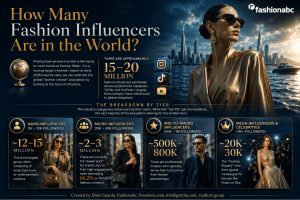
Pinning down an exact number is like trying to count trends at Fashion Week – it is a moving target. However, based on early 2026 industry data, we can estimate the global fashion creator population by looking at the tiers of influence. There are approximately 15 to 20 million fashion influencers worldwide across all platforms, Instagram, TikTok, and YouTube, ranging from hobbyist nano-influencers to global megastars.
The Breakdown by Tier
Global Fashion Influencer Marketing Market
The industry categorises influencers by their reach. While the “Top 100” get the headlines, the vast majority of the population belongs to the smaller tiers.
Nano-influencers, those with between 1,000 and 10,000 followers, number somewhere between 12 and 15 million globally. This is the largest group by far, often consisting of local style icons or niche aesthetic creators whose authority within their communities far exceeds what their follower count might suggest.
Micro-influencers, sitting between 10,000 and 50,000 followers, number around 2 to 3 million and are currently the sweet spot for brands, averaging engagement rates of 14.2% on TikTok for fashion content.
Mid-to-macro influencers, those between 50,000 and one million followers, number between 500,000 and 800,000, these are professional creators who typically derive their full income from fashion partnerships. At the top sit the mega-influencers and celebrities with over one million followers, numbering between 20,000 and 30,000 globally — the fashion royalty who front global campaigns for houses like Prada and Dior.
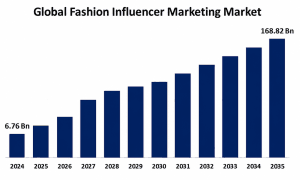
According to Spherical Insights, the Global Fashion Influencer Marketing Market was valued at USD 6.76 billion in 2024 and is anticipated to reach USD 168.82 billion by 2035, growing at a CAGR of 33.98% from 2025 to 2035.
Key Market Dynamics
The landscape has shifted significantly in the last two years, and the shifts are structural, not cyclical.
The professionalisation of content creation has reached a peak. Being a creator is now a lauded profession, not a side pursuit. The fashion influencer marketing market is expected to hit $11.1 billion this year alone, growing at a massive 32.9% CAGR, numbers that place it firmly among the most consequential sectors in the broader digital economy.
Simultaneously, we are witnessing the rise of the virtual influencer. AI-generated fashion personalities are proliferating across platforms, and while they are still viewed as less authentic by portions of the audience, research shows that Gen Z reports higher levels of empathy toward certain synthetic creators than toward human ones. This is not a marginal data point. It tells us something important about how the next generation relates to identity, performance, and trust in a digitally mediated world.
Video dominance is no longer a trend — it is the baseline. Short-form video on Reels and TikTok now sees 20% higher reach than standard image posts. If an influencer is not doing video, they are effectively invisible. And with the full adoption of TikTok Shop and Instagram’s marketplace features, the line between influencer and retailer has blurred beyond recognition. Approximately 49% of consumers now purchase products directly through an influencer’s post — a figure that signals not a marketing evolution but an infrastructural one.
Source: Global Fashion Influencer Marketing Market Size To Exceed USD 168.82 Billion by 2035: Industry Analysis Report. Release Date: Jul 2025 Author: Spherical Insights. The Global Fashion Influencer Marketing Market Size was valued at USD 6.76 Billion in 2024 and is Anticipated To Reach USD 168.82 Billion by 2035, Growing at a CAGR of 33.98% from 2025 to 2035. https://www.sphericalinsights.com/our-insights/fashion-influencer-marketing-market
The Top Fashion Influencers of 2026
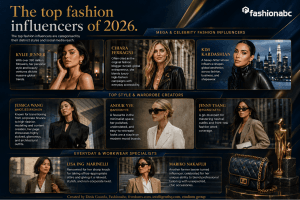
The top fashion influencers of 2026.
The major fashion influencers of 2026 are categorised by their distinct styles and social media reach.
At the mega and celebrity tier, Kylie Jenner, with over 390 million followers, continues to dictate global trends through her personal style and beauty ventures.
Chiara Ferragni, often cited as the original fashion blogger turned global entrepreneur, blends luxury high-fashion campaigns with everyday accessibility in a way that few have managed to replicate. Kim Kardashian remains a heavyweight whose influence shapes global aesthetics across fashion, business, and shapewear.
Among top style and wardrobe creators, Jessica Wang, known as @NotJessFashion, transitioned from corporate finance to high-fashion content creation and now showcases highly stylised, glamorous, and architectural outfits to a global audience.
Anouk Yve (@anoukyve) has become a favourite in the minimalist space, her polished and understated looks a staple on modern mood boards.
Jenny Tsang (@tsangtastic) is a go-to authority on neutral dressing and front-row fashion week coverage.
In the workwear and everyday specialist category, Lisa Ing Marinelli has built a following around her ability to take office-appropriate attire and give it a relaxed, stylish, non-corporate identity.
Mariko Nakafuji, another former lawyer turned influencer, is celebrated for her unique capacity to blend professional tailoring with unexpected, chic accessories.
Key Fashion Influencer Marketing Companies
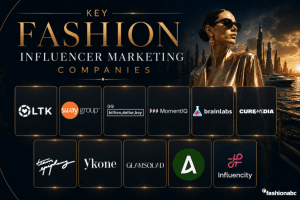
KEY FASHION INFLUENCER MARKETING COMPANIES
The companies leading the fashion influencer marketing market are not simply intermediaries. They are the architects of the infrastructure through which culture is now monetised — and understanding what each of them actually does is essential to understanding how the ecosystem functions as a whole.
- LTK (formerly rewardStyle) is where the modern influencer commerce stack arguably began. Founded in 2011, LTK operates as a premier end-to-end content monetisation platform for digital style influencers, with its flagship social commerce platform LIKEtoKNOW.it becoming a dominant global source for influencer-driven retail sales. The platform now drives $5 billion in annual brand sales through its integrated shopping app, powered by 14 years of proprietary performance data and an AI-matched creator network. That is not a marketing tool. That is a commerce infrastructure.
- Sway Group operates as a performance-first network, pairing brands with the right creators to deliver reach, engagement, and conversion at scale, with a network of over 45,000 US and Canadian-based influencers that consistently produces branded content exceeding average industry engagement rates.
- Billion Dollar Boy is, by any measure, the agency of the moment. Named Ad Age’s Social Media and Influencer Agency of the Year for 2026, its trajectory speaks for itself. In the last year, BDB’s revenue grew 48% and gross profit soared 33%, while its US operations saw EBITDA rise 99% — the agency’s most successful six months on record. Its client roster now includes Crocs, Burberry, IKEA, Adidas, and Sephora, with spending from existing clients rising 80% year-over-year. What BDB has understood — and executed on — is that creators are not a channel. They are the culture itself.
- MomentIQ has carved out a specialist position at the leading edge of live social commerce. The agency operates as a TikTok Shop partner focused on converting live commerce into measurable retail performance, holding distinctions including the ranking of number one partner for Paid Shop Ad ROAS and Top TikTok Shop Partner for Single Live Revenue. In a world where the line between content and transaction has all but disappeared, MomentIQ’s model is a preview of where the entire industry is heading.
- Brain Labs Digital brings a data science orientation to the creator economy — a reminder that the most effective fashion campaigns of 2026 are not built on instinct alone, but on rigorous performance architecture applied to creative execution.
- CURE MEDIA, operating out of Stockholm under the Online Media Sweden AB umbrella, has been one of Europe’s leading influencer marketing agencies since 2014, specialising in helping fashion brands elevate their influencer marketing through a blend of data-driven strategy and experience-led creative instinct. Its Nordic origins are not incidental — Scandinavia has long produced some of the most sophisticated thinking on digital culture and brand authenticity.
- TEAM EPIPHANY, founded by Coltrane Curtis — a former Vice President of Marketing at Marc Ecko Enterprises and founding member of G-Unit Apparel — is a full-service consumer marketing agency specialising in brand strategy, experiential marketing, multicultural and influencer engagement, social media amplification, and public relations. What Team Epiphany represents is the cultural intelligence layer that pure-data platforms cannot replicate.
- Ykone Group is one of the few agencies that has been operating at the intersection of fashion and influencer marketing long enough to have genuine institutional authority in the luxury segment. A full-service influencer marketing agency operating since 2008, Ykone has worked with brands including Armani Beauty, Alexander McQueen, Chopard, Mac Cosmetics, and Shiseido. Most recently, following its merger with MIRROR MIRROR, Ykone created ONE — the first group integrating influencer marketing, production, and events specifically for luxury brands. That consolidation is a signal worth noting.
- JMB GLAMSQUAD brings specialist expertise in the beauty and fashion adjacency space — the territory where personal styling, glamour production, and creator content intersect. In an era where getting ready is content, and content is commerce, that positioning is far less niche than it once appeared.
- AspireIQ has built its reputation as the platform of choice for brands that need to manage influencer relationships at scale across e-commerce environments. In 2025, AspireIQ introduced a fully customisable Influencer CRM and advanced ROI measurement suite tailored for e-commerce brands, enhancing scalability, content repurposing, ambassador programme management, and analytics precision. Brands like Calvin Klein have used Aspire for enterprise-level influencer campaign management.
- Influencity rounds out the list as one of the most capable enterprise-grade platforms for brands and agencies operating across multiple markets simultaneously. Fashion, beauty, and agency teams benefit from its modular pricing and strong ROI reporting — making it a practical solution for organisations that need both analytical depth and operational flexibility at scale.
What unites these companies, despite their different orientations and geographies, is the same underlying conviction: that influence, properly structured and measured, is not a soft metric. It is a business model.
Growth of Virtual and Synthetic Influencers
In 2026, more content creators will also be created — not born. Virtual and synthetic influencers are already proliferating across online platforms, though not all are enjoying the same level of traction or cultural resonance.
Research shows growing trust in virtual influencers, but public perception remains genuinely mixed. Consumers tend to show more empathy toward synthetic influencers than toward human creators in certain contexts, yet still find them less authentic overall. The tension between empathy and authenticity is one of the more philosophically interesting fault lines in the current creator economy — and it will not resolve cleanly.
Nonetheless, the prevalence of virtual influencers is rising with no signs of slowing. These influencers have already become key players in social media, crypto, and adjacent industries, and they possess the potential to rival human content creators in cultural influence in the years ahead.
What Fashion Influencers Tell Us About the Future of Culture, Commerce and Identity
The numbers are extraordinary, but the real story is not in the follower counts. What the global rise of the fashion influencer represents is something far more fundamental: the democratisation of cultural authority. For decades, fashion was dictated from the top down — by editors, by houses, by a handful of gatekeepers in Paris, Milan, and New York. That model is not merely disrupted. It is dismantled.
We are now living in a world where a nano-influencer in Seoul or São Paulo, with 3,000 followers and a clear aesthetic vision, can shape the purchasing decisions of her community more powerfully than a full-page spread in Vogue. That is not a marginal development. That is a civilisational shift in how we understand taste, trust, and influence.
What I find particularly compelling, and what the data around virtual and synthetic influencers begins to surface, is the question of authenticity in a world of constructed identity. Fashion has always been performance. The suit, the dress, the silhouette, these are never neutral. They are statements of self, of aspiration, of belonging. The emergence of AI-generated influencers does not betray that logic. It extends it. What changes is the origin point of the performance, not the performance itself.
The convergence of social commerce, short-form video, and creator monetisation platforms is creating something entirely new: a distributed retail layer built on trust networks rather than brand budgets. When 49% of consumers are already purchasing directly through an influencer’s post, we are not looking at a marketing channel. We are looking at a new form of economic infrastructure — human-scaled, community-anchored, and increasingly intelligent.
The Asia-Pacific trajectory is not a footnote. It is the headline. The next dominant aesthetic movements, the next global trends, the next wave of mega-influencers will not emerge exclusively from the West. They will come from the intersections of Chinese digital culture, Indian creative energy and South Korean precision and they will reach a global audience in seconds.
For brands, for investors, and for anyone building at the intersection of technology, culture, and commerce, the fashion influencer economy is a signal worth taking seriously. Not because of the follower counts, but because of what those followers represent: a global population that has chosen to organise its attention, its aspiration, and increasingly its spending around individuals it trusts rather than institutions it does not.
That is the real transformation. And it is only just beginning.


